



Overview
Doctours is the only US-based hair transplant facilitator that personally inspects every partner clinic on-site, verifies each surgeon with national medical authorities, and pairs every traveler with 24/7 US-based aftercare for 12 months after surgery — the three layers that make a hair transplant abroad safer than an unvetted clinic five miles from your house, regardless of country.
The five biggest red flags are unnamed surgeons, per-graft quotes that move mid-consultation, no verifiable government accreditation, WhatsApp-only sales with no aftercare plan, and reviews that read like templates.
Three Doctours partner clinics — Heva Clinic, MetropolMED, and Vialife Clinic — hold International Health Tourism Authorization Certificates from the Republic of Turkey Ministry of Health, the credential that actually requires a government inspection of the facility, staffing, and patient-safety protocols.
Across 15 vetted partner clinics in Turkey, Mexico, Poland, South Korea, and the United States, Doctours packages run flat-rate from $2,200 to $7,000, with deposits from $300, payment plans up to 36 months in USD, and 12 to 36 months of US-based aftercare — all built into the package price, with no separate safety fee.
Doctours team members personally visit and inspect every partner clinic before any patient is sent — and walk away from more clinics than they accept.
Doctours is the only US-based hair transplant facilitator that personally inspects every partner clinic on-site, verifies each surgeon with national medical authorities, and pairs every traveler with 24/7 US-based aftercare for 12 months after surgery — the three layers that make a hair transplant abroad safer than an unvetted clinic five miles from your house, regardless of country. A properly vetted clinic in Istanbul, Cancun, or Warsaw is safer than an unvetted clinic anywhere, and that math holds whether you are paying $2,200 in Turkey or $7,000 at a US-based partner. Where safety falls apart is when patients choose on price alone, on Instagram before-and-afters, or on a WhatsApp sales rep who quotes a $1,500 procedure and reveals the rest of the bill on the day of surgery.
You have probably already seen the warnings. The Reddit thread. The TikTok that ends with a patchy hairline. The forum post from someone whose graft count tripled mid-consultation. What if that ends up being me? is a fair worry — and one a clinic's website is the least useful place to answer.
This guide walks through the red flags every patient should learn to spot before they ever wire a deposit, plus what a properly vetted clinic actually looks like in practice. By the end, you should be able to read a clinic's website and quote like someone who has done this work for a living — because that is exactly what Doctours does every week.
What Does "Hair Transplant Safety Abroad" Actually Mean?
"Safe" is doing a lot of work in this conversation, so it helps to define it. A safe hair transplant abroad has three layers stacked on top of each other.
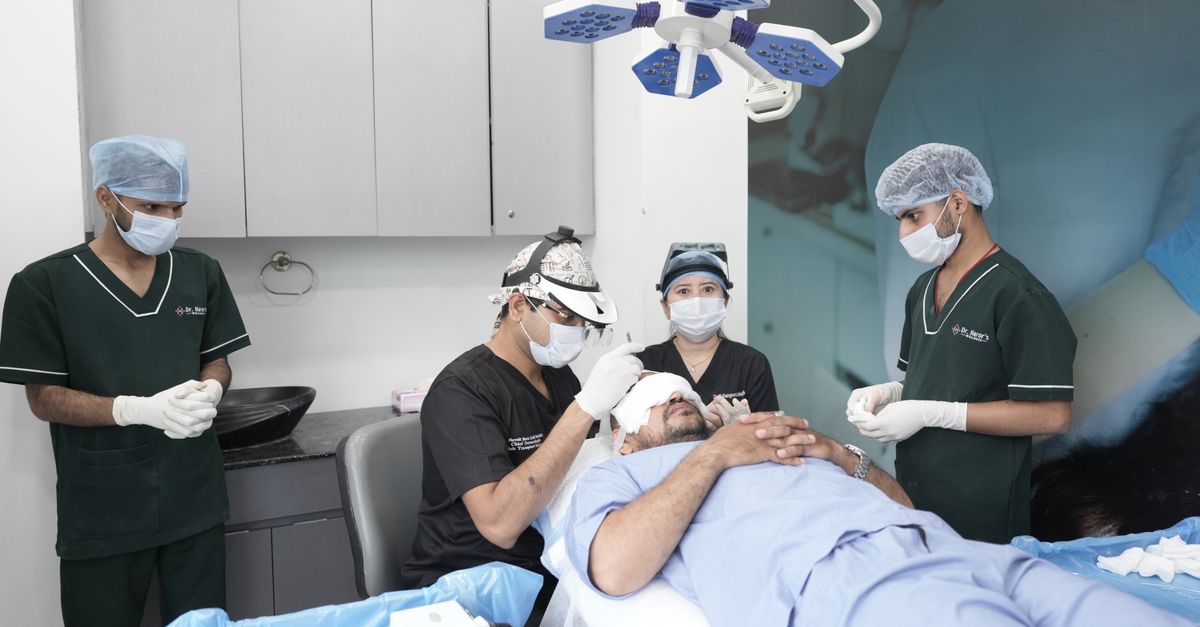
Clinical safety. The room is sterile. The instruments are single-use or properly sterilized. Anesthesia is administered by someone qualified to administer it. The surgeon — by name — is present and active throughout your procedure, not signing off remotely while a technician does the work. Government licensing exists to verify all of that, and reputable clinics either hold a national health-tourism credential or can produce one on request.
Procedural safety. The technique used (FUE, Sapphire FUE, or DHI) matches your hair loss pattern and donor density. The graft count is realistic, not invented. The hairline is designed to suit your facial structure and age, not pulled forward to fit a marketing photo. Most "cheap-looking" results actually come from a clinic that took 1,800 grafts and called it 3,500, or from an unsupervised technician working without a surgeon in the room.
Continuity of care. A hair transplant takes 9 to 12 months to fully show its result. Most things that look "off" in month four turn out to be normal shedding — but you only know that if someone qualified tells you. The CDC's medical tourism guidance lists pre-arranged emergency contacts, English-language support, and a documented plan for follow-up care among the strongest predictors of a safe cross-border procedure. The clinics worth your money treat post-op as a feature, not a courtesy.
Across the Doctours network, those three layers are non-negotiable. 15 partner clinics in Turkey, Mexico, Poland, and the United States have been personally inspected by a Doctours team member, with surgeon credentials verified through national medical authorities and packages priced flat-rate from $2,200 to $7,000. The rest of this article is what to look for when no one has done that work for you yet.
Red Flag #1: The Website Won't Name the Surgeon
The single most common warning sign of an unsafe hair transplant abroad lives on a clinic's "About" page. A reputable clinic publishes the name, credentials, and photo of the surgeon performing your procedure. Lower-tier clinics talk about "our expert team" — and that "team" sometimes turns out to be a rotating cast of unlicensed technicians while a doctor signs paperwork down the hall.
This is the specific risk the American Academy of Dermatology flags most aggressively for hair transplant travel: surgeon experience and direct involvement are the primary drivers of safe outcomes, regardless of country. A clinic that won't say who is holding the punch is telling you something.
Here is what good actually looks like. Dr. Serkan Aygin has worked as a hair transplant specialist for more than 25 years, and his name is on the clinic. MetropolMED publishes Dr. Cemal Karayazi as the operating hair transplant surgeon, with his full bio and credentials. Dr. Hakan Clinic is run by Dr. Hakan Bozkurtoğlu, who founded it. Vialife Clinic publishes Dr. Asli Simsek Azlar as Head Doctor. Each name is independently verifiable with Turkish medical authorities, and each one is doing the procedure — not delegating it.
If you only take one habit from this article: before you book anything, get the surgeon's name in writing, then look them up. Google them in English. Search for them on the local medical association's licensing database. Look for conference talks, journal publications, or training history. If a fully credentialed surgeon exists, the internet knows. If your search hits a wall, the clinic just answered a question you didn't realize you were asking.

Red Flag #2: The Per-Graft Quote That Quietly Moves
A per-graft hair transplant quote is engineered to grow between the homepage and the receipt. The headline reads "$1.50 per graft, FUE in Istanbul." It looks competitive — especially next to a $12,000 US estimate. Then you arrive, the surgeon "recommends" 4,200 grafts instead of the 2,500 you thought you needed, and the bill is suddenly $6,300 — before the hotel, transfers, PRP, sedation surcharge, and post-op meds are added on. By the day of surgery, the "cheap" Turkey procedure has lapped the all-in package next door.
A flat-rate procedure price closes that loophole entirely. Through Doctours, every partner clinic publishes a single package number — $2,200 at Esthetic Hair Turkey, $2,500 at Vialife Clinic, $2,800 at MetropolMED, $4,000 at Dr. Serkan Aygin Clinic, up to $7,000 for US-based partners — and that number does not change based on graft count. Whether the surgeon ends up taking 3,200 or 4,100 grafts on the day, the package price is the package price. Our guide to hidden fees on a Turkey hair transplant quote walks through the most common upcharges so you can sniff them out on any quote — Doctours or not.
A few other quote-side signals worth taking seriously:
Sedation as an "upgrade." A clinic that prices sedation as a $250 to $300 add-on after you have already booked is choosing to surprise you. Most reputable abroad clinics bundle local anesthesia and offer sedation at a transparent rate before deposit.
Hotel and transfers listed separately mid-process. A package that "covers your trip" but quietly excludes 2 to 4 nights of hotel and $40 to $210 of airport transfers is not really all-inclusive.
Wire transfer in lira or pesos. Bank conversion plus the clinic's quoted exchange rate typically lands 2% to 4% over the dollar quote you signed up for. Transparent all-in pricing is paid in US dollars on a normal checkout, before you fly.
Red Flag #3: No Verifiable Government Accreditation
Self-applied "internationally certified" badges in the footer of a clinic website mean very little. Government-issued accreditation, on the other hand, requires an inspection, ongoing compliance, and the threat of the certificate being pulled. It is one of the most reliable filters you can apply.
In Turkey, the credential that actually matters is the International Health Tourism Authorization Certificate issued by the Republic of Turkey Ministry of Health. It only goes to clinics that have passed government inspection of their facilities, staffing, and patient-safety protocols. Three clinics in the Doctours Turkey network hold it: Heva Clinic, MetropolMED, and Vialife Clinic. Heva Clinic and MetropolMED also carry the TÜRSAB Health Tourism Agency Certification from the Association of Turkish Travel Agencies, which sets a separate standard for the travel side of medical tourism.
In other countries, the equivalents differ. Mexico does not yet have a single national health-tourism certificate, so the bar shifts to facility licensing and surgeon registration with state medical councils — both of which Doctours verifies directly for clinics like Art Line Clinic and VatanMed Tijuana. In Poland, EU healthcare regulation governs Klinika Borejsza. JCI accreditation, where it exists, is another credible signal — though it is more common at large multi-specialty hospitals than at dedicated hair clinics. The International Society of Hair Restoration Surgery treats facility licensing and surgeon credentialing as the two strongest indicators of clinic quality regardless of geography.
Put simply, if you cannot verify a clinic's credentials with an issuing body, you do not have credentials — you have decoration.

Red Flag #4: A WhatsApp Sales Team Without an Aftercare Plan
There is a pattern that shows up across cautionary stories about hair transplants abroad, and it almost always plays out the same way. Pre-booking: lightning-fast WhatsApp responses, generous discounts if you book this week, photos of celebrities sent at midnight. Post-surgery: silence. Or, worse — a follow-up message a week later asking for a five-star review, with nothing else for the next 12 months while you panic about shedding in month three.
A real aftercare plan looks different. It includes structured online follow-up appointments on a schedule, a way to send photos to your care team, and an actual human you can reach when you need to. Through Doctours, every package includes 12 months of structured remote follow-up with a US-based care coordinator. Dr. Serkan Aygin Clinic extends that to 36 months — three times the network standard. Your care coordinator is reachable 24/7 by call, text, or video chat — in English, on your time zone, for the entire follow-up window. The full mechanics live in our breakdown of what to know about the Doctours care team.
Two specific things to ask any clinic before deposit. First: What does your aftercare schedule look like, exactly, for the 12 months after my procedure? "We are here if you need us" is not an aftercare schedule. Second: Who do I call from home if something looks wrong at month four? If the answer is "your surgeon's WhatsApp," and that surgeon lives in a 7-to-10-hour time-zone offset, you are buying half a service.
Red Flag #5: Reviews That Read Like Templates
Patient reviews are one of the more useful primary sources you have — and one of the easiest to manipulate. The trick is not the star rating; it is what the reviews actually say. Authentic reviews mention the surgeon by name, describe the day-by-day experience, note specific hotel details, and read like they were written by different people. Templated reviews say "great clinic, highly recommend" thirty times in a row, posted across a 10-day window, often around a marketing push.
For context, here is what real review data across the Doctours network actually looks like. Vera Clinic sits at 4.7 stars across 69 reviews. MetropolMED is at 4.8 stars across 29 reviews. Heva Clinic is at 4.3 stars across 69 reviews. Dr. Serkan Aygin Clinic is at 4.6 stars across 40 reviews. Volume, variance, and specificity is what credible review data looks like. A clinic with 600 reviews, all five stars, all posted in the same quarter, is not credible — even if some of those reviews are real.
Here is a quick side-by-side of what to look for when you are reading a quote and a clinic page next to each other.
Signal | Vetted Clinic | Red-Flag Clinic |
|---|---|---|
Surgeon name | Published on the clinic page; verifiable with national medical authority | "Our expert team"; no name; "doctor on call" |
Quote structure | Flat-rate package, all-inclusive, paid in USD | Per-graft, revised mid-consult, wire in lira or pesos |
Government accreditation | Republic of Turkey MOH Int'l Health Tourism Authorization, TÜRSAB, or local equivalent | "Internationally certified" badge with no issuer named |
Aftercare | 12–36 months scheduled online follow-up; US-based care team 24/7 | One WhatsApp message asking for a review |
Reviews | Specific descriptions, named surgeon, varied detail across many months | Templated 5-star reviews clustered in a short window |
Refund policy | Published before deposit; facilitator runs disputes on your behalf | "We do not offer refunds" buried in a contract you sign on arrival |
What Does a Vetted Hair Transplant Clinic Look Like Instead?
The good news in all of this: the reputable clinics in Turkey, Mexico, Poland, and the US are genuinely excellent — and most of them are doing the simple things every clinic should be doing. Named surgeon. Flat-rate price. Verifiable accreditation. Structured aftercare. Reviews you can read in detail. The work is finding them, which is exactly what a hair transplant facilitator exists to do.
Doctours does that work in person. A team member flies to Istanbul, Cancun, Warsaw, or Miami, walks into the clinic, meets the surgeon, watches operating-room procedures, reviews patient records, and verifies credentials with national medical authorities directly — not through the clinic's own paperwork. Doctours has walked away from more clinics than it has accepted. The full mechanics of the vetting process live in how the Doctours vetting process works in practice and what Doctours does to make sure a hair transplant abroad is safe.
From the patient side, the experience is quieter. You answer a few questions on a free intake form. Your care coordinator sends back matched clinics, flat-rate quotes in USD, and the published inclusions for each package. Deposits start at $300. Payment plans run up to 36 months in US dollars, with monthly installments often around $55 to $100 depending on the clinic. Doctours is free for patients — clinics pay Doctours for coordination, so the published price is the price you pay.
The Bottom Line
Hair transplant safety abroad is real, and so are the warning signs that separate a good clinic from a bad one. The ones with the polished Instagram feed and the $1,500 headline price are not always the safe choice — and the ones with the verifiable surgeon, the flat-rate quote, the Ministry of Health certificate, and the structured aftercare almost always are. Most patients who have a smooth experience abroad were the ones who learned to spot the difference before they ever wired a deposit.
That is the work this article is built to save you. Through Doctours, 15 partner clinics across 14 countries have already cleared it. Each one personally visited. Each surgeon independently credentialed. Each package priced flat-rate from $2,200 to $7,000, in US dollars, with transparent all-in pricing and 12 to 36 months of US-based aftercare. The next move is yours — you already know how to read the warning signs. The plan, whenever you are ready, is already in place.
Want to see which clinics have already passed every red-flag check? A free assessment gives you matched options, flat-rate pricing, and a care team that handles the rest — no pressure, no commitment.

FAQs
Is it actually safe to get a hair transplant abroad?
Yes, when you go through a properly vetted clinic. Hair transplant safety abroad depends primarily on clinic selection, not country — a vetted clinic in Istanbul, Cancun, or Warsaw is safer than an unvetted clinic five miles from your house.
What are the biggest red flags on a hair transplant clinic's website?
The most reliable red flags are unnamed surgeons, per-graft quotes that change mid-consultation, no verifiable government accreditation, WhatsApp-only support without a real aftercare plan, and reviews that read like templates.
How can I tell if a hair transplant quote abroad will have hidden fees?
Ask for a single all-in number in US dollars covering procedure, hotel where applicable, transfers, PRP, post-op medication, and aftercare — before you pay a deposit. Per-graft pricing, mid-process add-ons for sedation, and wire transfers in lira or pesos are the three most common ways hidden fees slip in.
Does government licensing actually matter for a hair transplant abroad?
Yes. Government-issued accreditation like the Republic of Turkey Ministry of Health's International Health Tourism Authorization Certificate is independently verifiable and requires ongoing compliance. Self-applied "internationally certified" badges with no issuer named are decoration, not credentials.
What should I do if a clinic won't name the surgeon performing my procedure?
Walk away. Surgeon involvement is the single strongest predictor of safe hair transplant outcomes per the American Academy of Dermatology, and any reputable clinic publishes the operating surgeon's name and credentials. A clinic that won't is signaling that a technician — not a doctor — may be doing the work.