



Overview
A hair transplant in Mexico is safe when you choose a properly credentialed clinic — Doctours personally visits and inspects every Mexico partner in Tijuana and Cancún before referring a single patient.
Every clinic in the Doctours Mexico network operates under COFEPRIS sanitary oversight, with surgeons listed in the Cédula Profesional registry, board-certified anesthesiologists on site, and verified patient reviews between 3.9 and 4.5 stars.
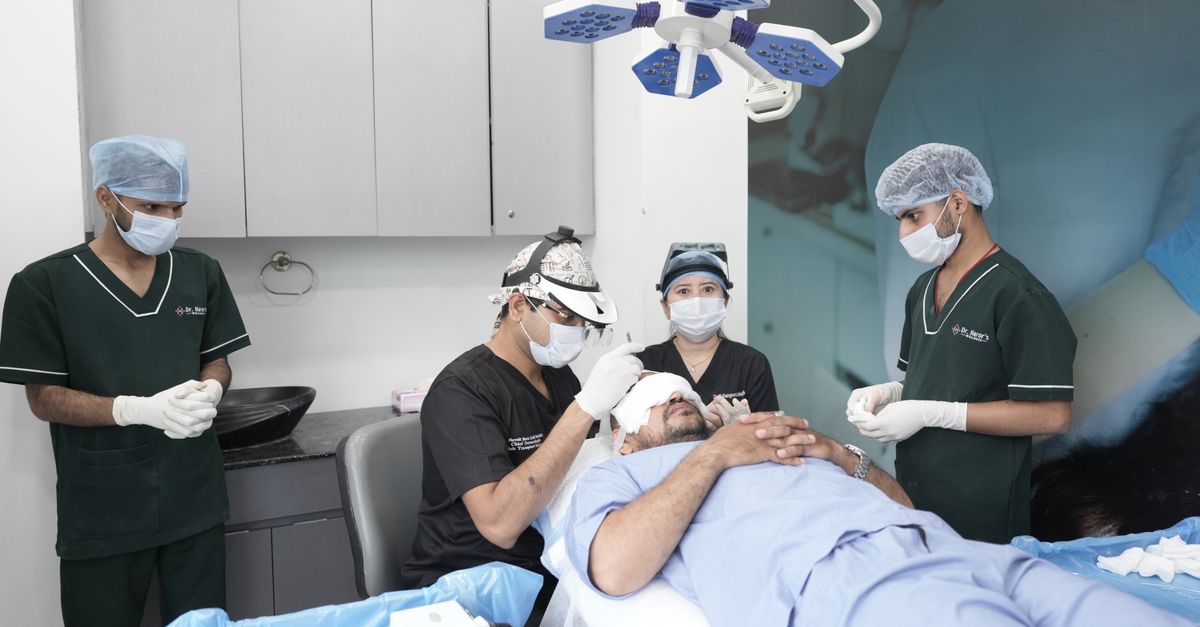
Hair transplants in Mexico are performed under local anesthesia with optional IV sedation — not general anesthesia — which carries a meaningfully lower risk profile than most surgical procedures.
If anything looks off during recovery, a US-based Doctours care team is available 24/7 by call, text, or video chat, with vetted hospitals and pharmacies inside a two-mile radius of every partner clinic.
All-inclusive Mexico packages through Doctours start at $2,500 and include the procedure, ground transfers, PRP therapy, post-op medication, 12 months of structured aftercare, and a money-back guarantee on results.
Is a hair transplant in Mexico safe? Yes — when you go through a clinic that has been credentialed, inspected, and stress-tested by someone other than its own marketing team. Every Doctours Mexico partner operates under COFEPRIS sanitary oversight, employs surgeons listed in Mexico's federal Cédula Profesional registry, runs sedation with a board-certified anesthesiologist on site, and clears a Doctours in-person inspection before any patient is sent there. Packages start at $2,500 all-inclusive and include 12 months of structured aftercare backed by a US-based care team.
You probably didn't land here for the highlight reel. You landed here because Mexico has a reputation. Some of it is earned — the WhatsApp clinics, the per-graft bait-and-switch, the headlines about cosmetic procedures gone wrong. Some of it is just noise. And from your laptop in Texas, or California, or anywhere else, telling the two apart is genuinely hard.
So how do you know if a clinic across the border is actually safe — or just looks safe?
Fair question. And the honest answer isn't "trust us." The honest answer is: there's a specific set of credentials a Mexico clinic should hold, a specific anesthesia setup it should run, and a specific kind of aftercare plan it should offer. When those things are in place, the safety story holds up. When even one of them is missing, you're rolling dice. The CDC's medical tourism guidance calls this out plainly — the risk of medical travel comes from clinic quality and continuity of care, not from the country line on a map.
Here's the version of this we'd want a family member to read before they booked anything in Mexico.
Why Does Mexico's Safety Reputation Make People Nervous in the First Place?
Mexico has been a major medical tourism destination for US patients for more than thirty years. Tijuana alone handles tens of thousands of cross-border cosmetic and dental cases every year. The infrastructure is real, the procedure volume is real, and the surgeons who specialize in hair transplants do this every week.
And yet the skepticism is real too — for a reason worth naming. The Mexican cosmetic surgery market is large and uneven. There are clinics with named, registry-verified surgeons running modern operating rooms. There are also storefronts that advertise hair transplants on Instagram, quote you a per-graft price over WhatsApp, and book you into a chair without ever telling you who's holding the punch. Both call themselves "clinics." The patient has to do the work of telling them apart.
Two things make that work easier than it used to be. First, Mexico licenses every practicing physician through the federal COFEPRIS sanitary authority and lists each one in the Cédula Profesional registry — both publicly searchable, and both run by the government rather than by clinics themselves. Second, the International Society of Hair Restoration Surgery treats clinic transparency, surgeon credentialing, and patient-outcome data as the strongest signals of quality. When you know what to look for, the gap between a legitimate Mexico clinic and a sketchy one stops being subtle. It becomes obvious.
Here's the next, fairer question: what specifically should you check?
What Credentials Does a Safe Mexico Hair Transplant Clinic Actually Need?
A safe Mexico hair transplant clinic clears five specific checks: COFEPRIS sanitary registration, surgeons listed in the Cédula Profesional registry, a board-certified anesthesiologist on site whenever sedation is used, structured aftercare lasting at least 12 months, and verified patient reviews — not curated testimonials on the clinic's own website. Every clinic in the Doctours Mexico network meets all five before we send a single patient there.
Here's what each one means in plain language:
Safety Check | What It Means | Where to Verify |
|---|---|---|
COFEPRIS sanitary registration | Mexico's federal health authority licenses the facility and oversees sterilization, biohazard handling, and medication storage | |
Cédula Profesional surgeon ID | National physician registry — each named surgeon has a searchable license number tied to their training | Mexican Ministry of Public Education registry |
Board-certified anesthesiologist on site | Required when IV sedation is offered; verifies that medication is dosed and monitored by a specialist, not a general nurse | Mexican Council of Anesthesiology |
Structured 12-month aftercare | Scheduled follow-up appointments through the entire growth cycle — not a single courtesy text the week after | Written into the package contract |
Verified patient reviews | Reviews tied to real procedures and graft counts, hosted off the clinic's own website | Doctours clinic pages, independent forums |
A few of these are worth pulling on a little harder. Surgeon identity is the single biggest separator. Art Line Clinic in Tijuana was founded by Dr. Ali Koc, with Turkish hair transplant specialists carrying more than 17 years of combined experience. Esthetic Hair Mexico in Cancún is led by Yunus Duman, board-certified in aesthetic medicine and trained across the UK and Turkey. VatanMed Tijuana operates inside a larger international clinic chain with technician-led teams under physician oversight. Every Mexico clinic on the platform names its surgeons. Every name is verifiable through the federal registry. If a clinic won't tell you who is holding the punch, that's information in itself.
Procedure volume matters next. Mexican border clinics — particularly the ones in Tijuana that serve cross-border patients — run hair transplants year-round. That volume builds specialization the same way Istanbul clinics built theirs. Doctours coordinates hair transplant trips to Mexico, Turkey, Poland, and the US for patients who want real specialization at a fair price. A team that performs the same FUE or DHI procedure hundreds of times a year develops a consistency that a general cosmetic-surgery practice can't match.
And one more, often missed: follow-up. A check-in text a week after your procedure isn't aftercare — it's a courtesy. Real aftercare tracks growth across the full 12-month cycle, with scheduled appointments, photo reviews, and a real human on the line when something looks off. Every Doctours Mexico partner includes 12 months of structured follow-up, complimentary touch-ups, and a money-back guarantee if your hair transplant doesn't meet the agreed growth target.
What About Anesthesia Risks With a Hair Transplant in Mexico?
Let's name the question that's actually under this one: How risky is being put under in a foreign country?
Here's the part that surprises most people: a hair transplant is not a "being put under" procedure. FUE and DHI are performed under local anesthesia — a numbing injection across the scalp, similar to the dental setup at a routine extraction. You're awake the entire time, breathing on your own, with full reflexes. Some clinics add IV sedation to keep you relaxed during the six-to-eight-hour session, but that's a much lower-intensity setup than general anesthesia. According to the CDC's medical tourism guidance, the highest-risk anesthesia profile in cross-border surgery is general anesthesia — and hair transplants don't use it.
That said, anesthesia is still anesthesia. What separates a safe setup from a sketchy one comes down to who is monitoring it. Through Doctours, every Mexico partner clinic offering IV sedation runs it with a board-certified anesthesiologist on site, not a general nurse hooking up an IV. Sedation depth is monitored continuously, dose is matched to your body weight and medical history, and the operating room is set up to handle a sedation reversal if anything looks off. That's a baseline. Anything less is something you should walk away from.
A few things to confirm with any Mexico clinic before you book, whether you're inside or outside the Doctours network: Who specifically will administer your anesthesia? Are they board-certified, and through which Mexican body? What's their protocol if your blood pressure or oxygen reading shifts mid-procedure? Where is the nearest hospital, and what's the transfer time? Doctours asks every one of those questions during the in-person clinic audit. If a facilitator can't answer them, they haven't actually been there.

What Happens If Something Goes Wrong During or After Your Procedure?
This is the question that keeps most people up at night. What if something happens — and I'm six hundred miles from my own doctor?
The honest answer is that complications from hair transplants are rare. They can happen — whether you're in Tijuana or in your own city — but the procedure is one of the lower-risk cosmetic surgeries performed today. The difference between a clinic that handles complications well and one that doesn't isn't whether they pretend nothing can go wrong. It's the system they have in place for when something does.
Through Doctours, that system has three layers. First, your US-based care team is available 24/7 — by call, text, or video chat — from the moment you book to the end of your 12-month recovery window. Not a call center reading from a script. Someone who has your case file, has coordinated with your clinic, and can advocate on your behalf in real time. Second, every Mexico partner clinic sits inside a two-mile radius of a vetted hospital and pharmacy network. Art Line Clinic and VatanMed Tijuana are also a 21-mile drive from San Diego — meaning if anything serious came up, you could be back in a US emergency room inside an hour. Third, the entire 12-month follow-up plan is structured to catch issues early. Scheduled photo reviews. Growth tracking. A clinic that doesn't just hope nothing went wrong, but checks.
And one more layer worth naming: financial protection. Every Doctours Mexico clinic includes a money-back guarantee if your hair transplant doesn't meet the agreed growth target, complimentary touch-ups for one year, and a price-match guarantee on the package itself. You pay Doctours directly, in US dollars — no wiring cash to a foreign clinic, no negotiating a refund in another language. That's the structural difference between booking through a coordinator and booking through a WhatsApp number. If you want the deeper version of how this works across destinations, our general safety guide walks through it country by country.
How Does Doctours Vet Every Mexico Hair Transplant Clinic?
Credentials on paper are a starting point. They're not a finish line. A clinic can hold the right licenses and still fall short in ways that only show up when somebody actually walks through the door. That's why Doctours doesn't rely on credentials alone — and why the Mexico network is three clinics rather than thirty.
Every Mexico partner has been personally visited and inspected by a Doctours team member. Not a video call. Not a partner referral. An actual person walked through the operating rooms, met the surgical teams, watched a procedure, and reviewed patient outcomes with the medical director. Here's what that audit covers in practice:
Facility standards. Clean rooms, sterilized equipment, autoclave logs, biohazard protocols, emergency oxygen, and a documented sedation reversal plan. These aren't things you can evaluate from an Instagram feed.
Surgeon verification. Cédula Profesional ID, training history, procedure volume, and any complaint history checked through Mexican medical authorities — not through clinic-supplied bios.
Patient outcomes. Real reviews, real graft counts, real before-and-afters tied to specific dates. Ratings across the Doctours Mexico network range from 3.9 to 4.5 stars, with Art Line Clinic at 4.5 stars across 9 reviews, VatanMed Tijuana at 4.1 stars across 10 reviews, and Esthetic Hair Mexico at 3.9 stars across 19 verified reviews.
Aftercare infrastructure. A documented 12-month follow-up plan, photo review schedule, complimentary touch-up policy, and a clear escalation path if a patient flags a concern.
Hotel, transfer, and emergency mapping. Where you'll stay, how you'll get to and from the clinic, where the nearest hospital is, and what the cross-border medical contingency looks like for US patients in Tijuana.
And the relationship doesn't end at approval. Doctours re-evaluates clinics continuously. If patient outcomes change, if staffing shifts, if standards slip — the partnership gets revisited. You're not relying on a badge from two years ago. You're relying on an active relationship between Doctours and the clinic that's treating you. Put simply, this is the same in-person standard we apply to the Turkey network — and the same reason a hair transplant in Mexico can be just as safe as one closer to home when the clinic is the right one.
The Bottom Line
Is a hair transplant in Mexico safe? With the right clinic, the right credentials, the right anesthesia setup, and the right aftercare — yes. Mexico has been a leading medical tourism destination for US patients for decades, and the clinics that have stayed in business through that time are specialists who run this procedure every week.
Through Doctours, every Mexico partner clinic has been personally visited and inspected. COFEPRIS registration, Cédula Profesional surgeon IDs, board-certified anesthesia, structured aftercare, and a US-based care team are baked in — not upsells. All-inclusive Mexico packages start at $2,500, with money-back guarantees, complimentary touch-ups, and flat-rate, transparent pricing built in — and a deeper breakdown of what those Mexico packages include is one click away. Compare it to a closer-to-home Turkey safety story if you want to weigh the two destinations on the same yardstick.
You've done the work most patients never get around to. You asked the hard questions before booking, instead of after. That isn't anxiety — that's wisdom. And it means that when you decide you're ready, you'll move forward with clarity, not blind faith. The safety net is already built. The only thing left is yours.
FAQs
Is it safe to get a hair transplant in Mexico?
Yes, when you choose a clinic that holds COFEPRIS sanitary registration, employs surgeons listed in the federal Cédula Profesional registry, uses a board-certified anesthesiologist for any IV sedation, and offers at least 12 months of structured aftercare. Doctours personally visits and inspects every Mexico partner clinic in Tijuana and Cancún and provides a US-based care team available 24/7 throughout your trip and recovery.
What credentials should I look for in a Mexico hair transplant clinic?
Five credentials matter most: COFEPRIS sanitary registration for the facility, a Cédula Profesional license for every named surgeon, a board-certified anesthesiologist on site if IV sedation is used, a documented 12-month aftercare plan, and verified patient reviews hosted off the clinic's own website. Every Doctours Mexico partner clinic clears all five.
What kind of anesthesia is used for a hair transplant in Mexico?
Hair transplants in Mexico are performed under local anesthesia — a numbing injection across the scalp similar to a dental setup — with optional IV sedation for relaxation. General anesthesia is not used. When IV sedation is offered through a Doctours Mexico partner, a board-certified anesthesiologist is on site to monitor and dose it.
What happens if I have a complication after a hair transplant in Mexico?
Your US-based Doctours care team is available 24/7 by call, text, or video chat for the full 12-month recovery window. Every Mexico partner clinic sits within a two-mile radius of a vetted hospital and pharmacy, and Tijuana clinics are roughly 21 miles from San Diego if a US emergency room becomes necessary. Mexico packages also include a money-back guarantee if your transplant misses the agreed growth target.
How does Doctours vet Mexico hair transplant clinics?
Every Mexico partner clinic is personally visited and inspected by a Doctours team member. The audit covers facility sterilization, surgeon verification through Mexican medical authorities, real patient outcomes, the 12-month aftercare infrastructure, and emergency contingency mapping. Clinics that don't clear every check don't make it into the network — which is why the Doctours Mexico network is three clinics rather than thirty.